
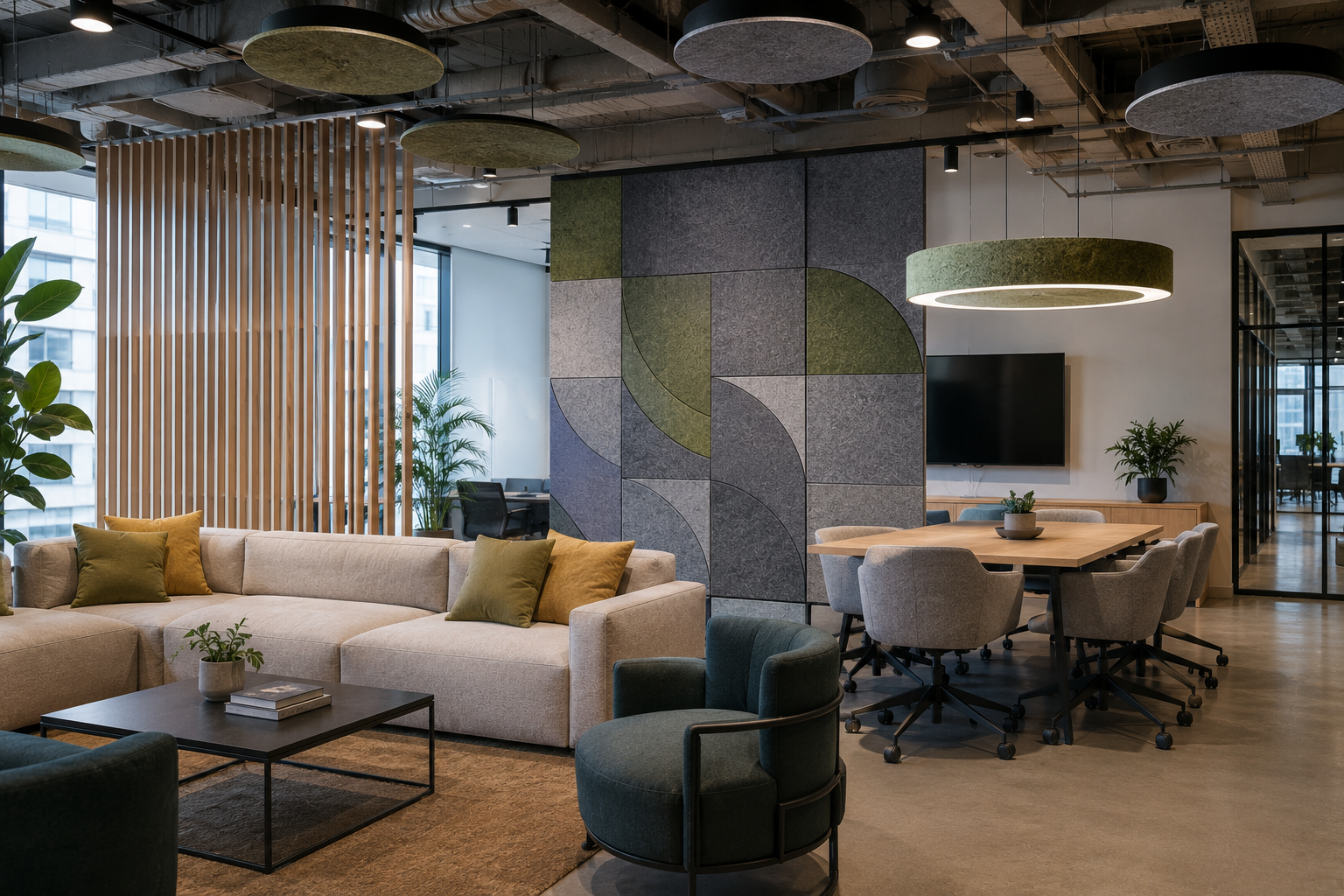
A product that solves a real problem and brings revenue to the partner
Noisy offices, reverberant restaurants, echo-filled meeting rooms, and children’s rooms where sound travels throughout the entire home are common challenges for clients. However, many people do not realise that acoustic comfort can be improved without major renovation work or compromising the interior design.
This is where an opportunity for a partner emerges.
PHONITURA creates acoustic panels, ceiling systems, partitions, luminaires, and decorative elements made from Archifonic material. Our products improve room acoustics, enhance interior design, and meet the growing demand for sustainable materials.
This is not a product that needs to be pushed onto customers. It addresses a clear need, strengthens the overall project, and creates an additional source of revenue.
Why acoustic solutions are in demand
Modern architecture makes extensive use of glass, concrete, metal, porcelain stoneware, high ceilings, and open-plan layouts. These spaces may look impressive, but hard surfaces reflect sound.
As a result, users experience:
- excessive reverberation and prolonged echo;
- poor speech intelligibility;
- increased fatigue;
- difficulty concentrating;
- acoustic discomfort in public and residential spaces.
Conventional decorative materials do not always solve these problems. PHONITURA products combine a distinctive appearance with effective sound absorption.
A partner offers the client not just another decorative element, but a measurable improvement to the space.
For interior designers and architects
Add a function to your project that the client will genuinely notice
A beautiful interior can lose much of its value if it is difficult to hold a conversation, work, or relax in the space. Acoustic problems are often discovered only after the renovation has been completed.
For a designer, this creates the risk of:
- client dissatisfaction;
- additional remedial work;
- disruption of the original concept;
- complaints about the comfort of the space;
- reputational damage.
Working with PHONITURA makes it possible to consider acoustics at an early stage and turn a technical requirement into part of the design concept.
Archifonic can be used to create:
- wall compositions;
- ceiling baffles;
- sculptural suspended structures;
- acoustic luminaires;
- partitions;
- decorative panels;
- three-dimensional objects;
- furniture elements;
- custom products based on individual sketches.
The material supports complex geometry, a wide colour range, perforation, digital cutting, and integration with lighting. Designers are not limited to a standard catalogue and can develop their own shapes and configurations.
What the designer receives
- assistance with preliminary acoustic calculations;
- selection of the required material coverage;
- advice on the positioning of acoustic elements;
- samples and colour palettes;
- visualisation materials;
- technical documentation;
- cost estimates;
- production based on individual drawings;
- project support;
- partner remuneration.
You retain authorship and control over the design concept. We take responsibility for the technical and production stages.
Why cooperation does not put your reputation at risk
Designers need to understand exactly what they are recommending to their clients.
PHONITURA products:
- address genuine problems with noise and reverberation;
- become an integral part of the interior;
- reflect current architectural trends;
- are manufactured from recycled PET-based material;
- can be adapted to the style of each project;
- do not need to be concealed behind additional finishes;
- improve comfort and the perceived quality of the space.
This is an opportunity to earn not by selling random decorative products, but by providing a professional solution to a real client need.
For interior showrooms and retail stores
Expand your product range with solutions that offer a clear advantage
The market for decorative panels, luminaires, and interior products is highly competitive. Customers often struggle to understand why one visually similar product costs more than another.
Acoustic products give retailers a strong and easy-to-explain advantage: they not only enhance the interior, but also help reduce reverberation, sound reflections, and overall acoustic discomfort.
For a store, this creates an opportunity to develop a new product category at the intersection of:
- interior design;
- lighting;
- office equipment;
- acoustics;
- sustainable materials;
- architectural décor.
Products that can be added to the range
- wall-mounted acoustic panels;
- ready-made modular compositions;
- decorative acoustic artwork;
- suspended acoustic elements;
- ceiling baffles;
- desktop and floor-standing partitions;
- acoustic luminaires;
- products for home offices;
- solutions for children’s rooms;
- acoustic kits for meeting rooms and offices.
The range can be developed gradually, starting with accessible standard products and expanding to custom-made solutions for individual projects.
What the store receives
- partner pricing;
- a retail margin on product sales;
- catalogues and material samples;
- photographs and visualisations;
- product specifications and descriptions;
- assistance with staff training;
- consultations for complex enquiries;
- calculations for custom projects;
- support in preparing commercial proposals;
- the ability to accept orders for non-standard products.
The store does not need to become an acoustic consultancy. It is enough to identify the client’s need and provide the project parameters. Our specialists will assist with the next stage of product selection and calculation.
For online stores and marketplaces
A scalable product category
For e-commerce, products need to offer a clear function, strong visual appeal, and the ability to be developed into a structured product range.
Acoustic products can be listed in categories such as:
- home products;
- office interiors;
- lighting;
- wall panels;
- partitions;
- interior décor;
- studio equipment;
- home office products;
- solutions for children’s rooms;
- HoReCa.
The products can be presented effectively through photographs, application diagrams, video content, product comparisons, and ready-made interior scenarios.
Cooperation formats
Sales of standard products
The partner lists ready-made models with defined specifications, dimensions, and colour options.
Made-to-order sales
A standard product is displayed on the platform, while the colour, shape, quantity, and other parameters are confirmed after the order is placed.
Project enquiries
The customer submits a request for an acoustic solution for a specific space. The enquiry is then processed jointly with PHONITURA.
Exclusive collections
For major partners, we can discuss exclusive collections, dimensions, colour combinations, or product sets.
What the partner receives
- ready-made product listings;
- descriptions and technical specifications;
- photographs and video materials;
- application examples;
- category recommendations;
- SEO content;
- product range consultations;
- assistance in selecting an initial product matrix;
- updated materials when new products are launched;
- an agreed order-processing procedure.
The specific supply model, pricing structure, and logistics arrangement are determined individually, taking into account the platform and expected sales volume.
How the partner earns
The partner programme may include several cooperation models.
| Partner | Source of income |
|---|---|
| Interior designer or architect | Remuneration for products included in a completed project |
| Interior showroom | Retail margin and sales of additional solutions |
| Online store | Margin on standard and made-to-order products |
| Marketplace seller | Sales of a scalable product range |
| Design practice | Revenue from comprehensive project development and support |
| Procurement specialist | Remuneration for including the products in the project specification |
The level of discount, remuneration, or margin depends on the cooperation model, order volume, and product mix.
Why the product is easy to sell
It addresses a clear problem
The client may not know the name of the material, but understands the problem:
- the office is too noisy;
- it is difficult to hold a conversation in the restaurant;
- there is an echo in the meeting room;
- it is impossible to concentrate in the office;
- sound from the children’s room travels throughout the home.
The conversation can begin with the real-life situation rather than with technical specifications.
It is visually noticeable in the interior
Panels, partitions, and luminaires can be demonstrated using photographs, visualisations, and physical samples. The customer can clearly understand how the product will look in the space.
It creates opportunities for additional sales
Along with wall panels, the customer can also be offered:
- ceiling elements;
- partitions;
- acoustic lighting;
- additional modules;
- a custom composition;
- acoustic solutions for adjacent rooms.
This increases the average order value and makes it possible to move from selling an individual product to creating a comprehensive interior solution.
It is suitable for a wide range of market segments
The products are relevant for:
- offices;
- coworking spaces;
- restaurants;
- hotels;
- schools;
- kindergartens;
- libraries;
- healthcare facilities;
- retail spaces;
- studios;
- home offices;
- children’s rooms;
- residential interiors.
The partner is not dependent on a single narrow customer segment.
How cooperation begins
1. We define the cooperation model
You tell us how your business operates: whether you manage private projects, run a showroom, sell through an online store, or develop a marketplace storefront.
2. We select the product range
For a designer, this may involve a sample kit and project-based cooperation. For a store, it may be an initial collection. For a marketplace, it may be a range of standard products with clear specifications.
3. We provide the necessary materials
The partner receives photographs, descriptions, specifications, catalogues, and consulting support.
4. We establish the order-processing procedure
We agree on how enquiries are transferred, how projects are calculated, how custom products are approved, and how orders are fulfilled.
5. We develop sales together
We analyse demand, expand the product range, create product bundles, and introduce new product categories.
Let us create spaces that are not only visually impressive, but also comfortable to use
PHONITURA invites the following professionals and businesses to cooperate:
- interior designers;
- architects;
- design practices;
- procurement specialists;
- furniture and interior showrooms;
- lighting stores;
- online retailers;
- marketplace sellers;
- companies working with offices and the HoReCa sector.
You receive a modern product, manufacturer support, and an additional source of revenue. Your client receives a visually appealing space with carefully considered acoustics.
Send us information about your company, store, or design practice. We will propose a suitable partnership model and prepare the cooperation terms.