
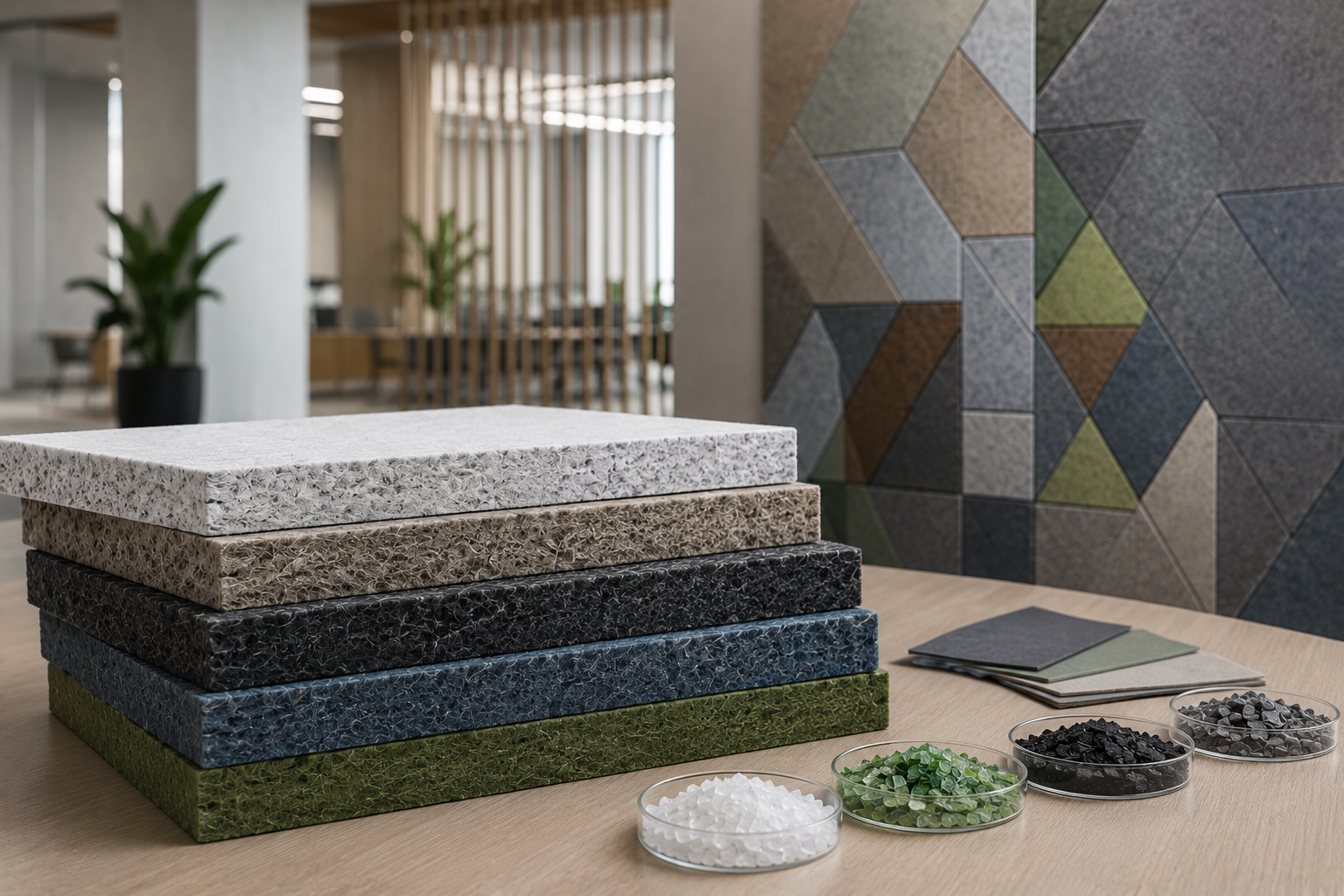
✨ ARCHIPHONIC is more than a material. It is a foundation for the architecture of the future: sustainable, expressive and highly functional.
Key advantages:
- enhanced acoustic performance at the same material thickness;
- an extensive colour palette developed in line with international interior trends;
- compatibility with CNC cutting, laser perforation and flexible three-dimensional forming;
- resistance to impact, mechanical damage and everyday wear;
- extensive customisation options, from colour and shape to texture and surface treatment.
Manufacturing Process and Material Composition
1. Collection and Preparation of Raw Materials
PET bottles collected through separate waste collection and recycling systems are used as the primary raw material.
On average, approximately five plastic bottles are recycled to produce one module, helping to reduce plastic waste and the overall environmental impact of the product.
The collected material is:
- sorted;
- separated from caps and labels;
- cleaned;
- shredded into PET flakes.
2. PET Recycling and Fibre Production
The PET flakes are melted at approximately 260°C and extruded into fine fibres.
The fibres then undergo thermal stabilisation to provide strength, dimensional stability and consistent performance.
3. Integration of Fire-Resistant Components
The material consists of:
- 75% PET fibres;
- 25% fire-resistant components.
These components may include:
- technical fabric used as a reinforcing layer;
- mineral fillers containing flame-retardant additives;
- hydrated aluminium compounds;
- silicate-based compositions that help limit heat and flame development.
4. Layer Formation
The fibres are arranged into a multi-layer mat available in thicknesses of:
6, 9, 12 and 24 mm.
The layers are bonded through hot pressing under high pressure, without the use of toxic adhesives.
Where required, a water-based resin suitable for projects working towards LEED or BREEAM requirements may be used.
5. Thermal Setting and Cutting
The final thermal-setting process gives the material its stable shape and dimensional consistency.
The sheets can then be processed into:
- acoustic panels;
- ceiling fins and baffles;
- three-dimensional elements;
- decorative structures;
- bespoke architectural products.
Openings for lighting, wiring and other technical services can also be incorporated during production without compromising the intended performance of the finished element.