
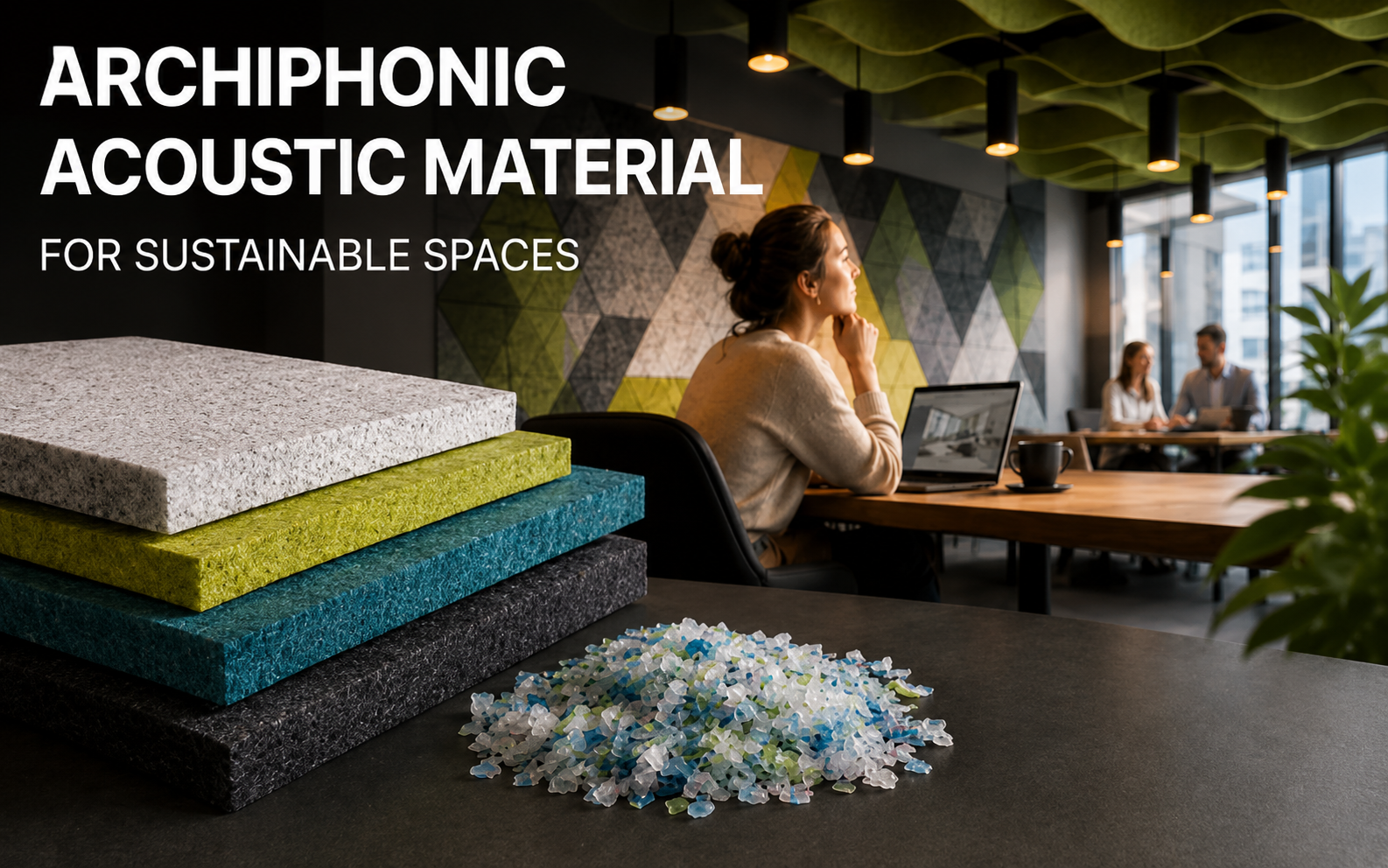
PET Felt and High-Performance Acoustics: Why ARCHIPHONIC Is Transforming Interior Design
Noise is a constant feature of modern life. Whether in a busy office, home cinema or recording studio, the need for effective acoustic treatment and greater sound comfort has never been more relevant.
Among the many materials available today, PET felt has emerged as one of the most versatile solutions. Below, we explain what it is, how it is produced and why it is increasingly used in contemporary acoustic interiors.
1. What Is PET Felt?
PET felt, also known as polyester felt, is a non-woven material made from polyethylene terephthalate fibres. PET is the same type of plastic widely used for beverage bottles and packaging.
ARCHIPHONIC is a next-generation interior acoustic composite designed to combine acoustic performance, environmental responsibility, durability and enhanced fire performance.
How ARCHIPHONIC PET Acoustic Material Is Produced
Recycled PET as the Primary Raw Material
ARCHIPHONIC is manufactured predominantly from recycled PET bottles.
Polyethylene terephthalate is a thermoplastic polymer valued for its mechanical strength, dimensional stability and durability. On average, approximately five to seven recycled PET bottles are used to produce one standard ARCHIPHONIC acoustic panel.
This gives existing plastic a new purpose and supports the principles of circular design and more responsible construction.
Sorting and Preparation
At the first stage, the PET material is carefully sorted according to colour, contamination level and density. This helps ensure consistency in the fibres and stable performance in the finished product.
The bottles are then:
- separated from labels and adhesives;
- cleaned of contaminants;
- shredded into small flakes or granules;
- washed at high temperature;
- dried to remove residual oils, sugars and other impurities.
Fibre Formation
The prepared PET material is fed into an extrusion system and processed through several stages:
- melting at approximately 250–280°C;
- extrusion through a filtration and spinneret system to create fine fibres;
- rapid cooling;
- stretching of the fibres to improve strength and structural stability.
The result is a fine, durable and safe polyester fibre suitable for further forming.
Thermal Bonding and Three-Dimensional Structure
The PET fibres are distributed in layers and pressed under controlled temperature and pressure.
Thermal bonding allows the fibres to connect without conventional adhesive resins. The multi-layer arrangement creates an acoustically active porous structure that helps dissipate sound energy across a broad frequency range.
The orientation and density of the fibres are designed to reduce reflected sound and improve acoustic comfort, particularly within the speech-frequency range.
Enhanced Fire Performance
To achieve improved resistance to ignition and flame spread, fire-retardant technologies may be incorporated into the material structure and production process.
Depending on the product specification, these may include:
- mineral-based fire-retardant additives;
- aluminium hydroxide;
- magnesium hydroxide;
- phosphorus-based compounds;
- silicate- or boron-based fire-resistant components;
- additional barrier layers treated with fire-retardant formulations.
The required fire classification should always be confirmed by the relevant product test reports and certificates for the intended market and application.
2. Why Is PET Felt So Effective for Acoustics?
Acoustic materials generally address two different objectives:
- sound absorption, which reduces echo and reverberation within a room;
- sound insulation, which limits sound transmission between different rooms.
PET felt is primarily a sound-absorbing material. It can also form part of a wider sound-insulation system, but its principal function is to improve the acoustic quality of the space in which it is installed.
2.1 High Sound Absorption
The structure of PET felt consists of countless fine fibres forming a complex porous network.
When sound waves enter this structure, they interact repeatedly with the fibres. Part of the sound energy is dissipated through friction and converted into a very small amount of heat.
This process helps to:
- reduce reverberation;
- control echo;
- minimise excessive background noise;
- improve speech intelligibility;
- create a calmer acoustic environment.
2.2 Performance Across a Broad Frequency Range
Many thin acoustic materials are most effective at higher frequencies. PET felt can provide useful absorption across mid and high frequencies, which are particularly important for speech clarity and everyday acoustic comfort.
Performance at lower frequencies depends on several factors, including:
- material thickness;
- density;
- distance from the supporting surface;
- the presence of an air gap;
- panel geometry;
- installation method.
For home cinemas, recording studios and other spaces with demanding low-frequency requirements, PET felt is often combined with additional acoustic constructions.
2.3 Aesthetics and Function in One Material
PET felt is not simply a technical acoustic product.
It has a soft, tactile surface, is available in a broad range of colours and can be cut into almost any shape — from simple geometric panels to complex three-dimensional forms and flowing compositions.
This makes it possible to create acoustic elements that become an intentional part of the interior rather than something that needs to be concealed.
ARCHIPHONIC can be used for:
- decorative wall panels;
- ceiling baffles;
- suspended structures;
- acoustic luminaires;
- space dividers;
- three-dimensional compositions;
- branded patterns;
- bespoke architectural installations.
2.4 Environmental Responsibility and Indoor Safety
Recycled content
PET felt gives existing plastic a second life and reduces demand for newly produced raw materials.
Resin-free fibre bonding
Thermal bonding can eliminate the need for conventional formaldehyde- or phenol-based adhesive resins used in some other fibrous products.
Low-dust installation
PET felt does not release brittle mineral fibres during normal handling and is generally comfortable to work with during installation.
Resistance to biological growth
PET itself does not provide a favourable nutrient source for mould, fungi or microorganisms. However, all installed materials should still be protected from persistent moisture, contamination and unsuitable environmental conditions.
2.5 Practicality and Long-Term Performance
Dimensional stability
The material is resilient and maintains its form when correctly specified, manufactured and installed.
Moisture resistance
PET does not readily absorb atmospheric moisture and is not susceptible to rot in the same way as natural organic materials.
Ease of installation
Depending on the product and fixing system, PET acoustic elements can be installed using:
- adhesive systems;
- mechanical fixings;
- suspension cables;
- ceiling rails;
- modular frames;
- freestanding structures.
Many simple panel systems are suitable for straightforward installation, while complex suspended or large-format elements should be fitted by qualified professionals.
3. Where Is Acoustic PET Felt Used?
Open-Plan Offices and Coworking Spaces
PET acoustic products help reduce general background noise, improve concentration and create more comfortable zones for individual work and meetings.
Restaurants, Cafés and Hospitality Interiors
Acoustic panels, baffles and luminaires help control the build-up of sound created by conversations, music, tableware and hard interior surfaces.
Educational Environments
Classrooms, lecture halls, libraries and communal areas benefit from improved speech intelligibility and reduced reverberation.
Architectural and Interior Design Projects
PET felt can be used to create:
- feature walls;
- sculptural ceiling installations;
- functional decorative elements;
- branded compositions;
- colour-based zoning;
- integrated acoustic lighting.
Home Cinemas and Media Rooms
The material helps reduce unwanted reflections and improve the clarity of dialogue, music and sound effects.
Recording and Podcast Studios
PET felt can support the creation of a more controlled recording environment by reducing excessive room reflections and reverberation.
For professional studios, it should be incorporated into a complete acoustic design rather than used as the only treatment.
Conclusion
PET felt is a modern, efficient and highly versatile material that has significantly expanded the possibilities of acoustic interior design.
It combines qualities that were once difficult to achieve within a single product:
- effective sound absorption;
- recycled content;
- low-maintenance performance;
- ease of processing;
- visual flexibility;
- extensive possibilities for bespoke design.
By choosing ARCHIPHONIC PET felt, you are selecting more than a sound-absorbing product. You are choosing a comprehensive solution for acoustic comfort, visual quality and more responsible interior design.