PHONITURA / ARTICLE
Children’s rooms: reverberation and transmitted noise
Seven ways to assess the room’s sound
Children’s play creates sound inside the room and may also transmit noise to neighbouring spaces. These are different acoustic problems and need different forms of assessment.
Soft furnishings and acoustic products can help control reflections within the playroom. Sound transmitted through a floor, wall or ceiling depends on the building construction.
Begin by identifying which problem you need to address.
1. Use Carpets, Curtains and Soft Furnishings
Review the balance of hard and soft surfaces in the room.
Rugs, curtains and upholstery can add absorption and soften contact between toys and the floor. Their effect depends on the material, coverage and installation.
A room with many uncovered hard surfaces may have pronounced reverberation.
Tip: Compare the proposed soft surfaces with the room’s layout and intended use.
2. Position Furniture Strategically
Furniture changes the arrangement of surfaces and routes through the room.
Bookcases, storage and upholstery can interrupt large reflective areas. Coordinate them around the room’s activities and circulation.
Furniture against a shared wall does not establish sound insulation through that wall.
Tip: Use furniture to organise the room, and assess transmitted noise separately.
3. Reduce Hard, Reflective Surfaces
Large areas of bare wall, glass and other hard finishes reflect sound into the room.
To reduce these reflections, consider adding:
- fabric wall coverings;
- acoustic wall panels;
- textile artwork;
- upholstered decorative elements;
- acoustic wall art or shaped felt compositions.
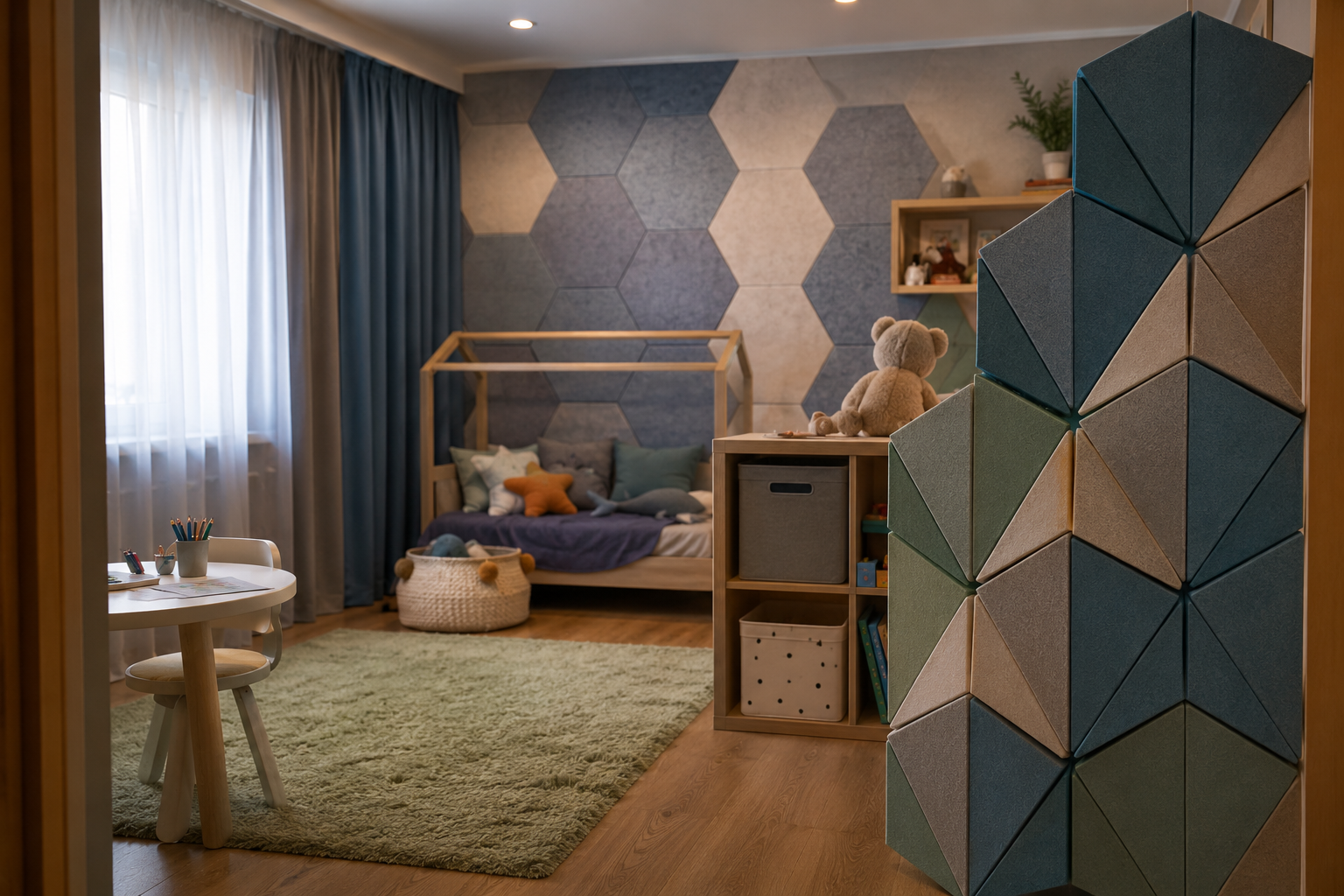
Phonitura panels and acoustic artwork bring sound-absorbing material into a visible wall finish.
Tip: Select treatment coverage around the room’s acoustic needs and available wall area.
4. Add Acoustic Partitions
A freestanding screen may provide a way to introduce local sound absorption when fixed treatment is impractical.
Review the screen’s position, stability, fixing requirements and suitability for the intended setting. The felt contributes absorption within the room.
They can also divide the room into separate areas for:
- active play;
- studying;
- reading;
- rest.
Tip: A screen can provide visual separation and local absorption; it does not create an enclosed, acoustically isolated room.
5. Improve Ceiling Acoustics
Suspended acoustic forms can add absorption beneath a reflective ceiling. Check mounting, clearances and the overall treatment scheme.
Noise from the flat above may travel through the building structure. A building-acoustics specialist should assess the transmission paths before a ceiling construction is specified.
Tip: Coordinate ceiling treatment with the supporting structure and the product’s installation requirements.
6. Address Impact and Structure-Borne Noise Correctly
Footsteps and dropped objects can excite the floor or other building elements, allowing sound to travel beyond the room.
A specialist may assess the need for:
- resilient floor underlays;
- floating floor systems;
- isolated ceiling constructions;
- decoupled wall linings;
- acoustic insulation;
- high-density barrier membranes.
Exposed PET felt treatment addresses reflections within the room. It does not replace a specified sound-insulation construction.
Tip: Identify the transmission path before selecting a wall, floor or ceiling intervention.
7. Create a Dedicated Play Zone
A defined activity area helps organise the room around play, study and rest.
Coordinate soft floor finishes, storage and any acoustic treatment with the play area. Assess mounting and placement for the intended use.
Review the whole room rather than expecting one object to resolve its acoustic behaviour.
Tip: Consider the location of active play alongside adjoining rooms and the building layout.
Choose treatment for the right problem
The aim is a room that supports its intended activities with a considered acoustic environment.
Furnishings and acoustic products can help manage reflections inside the room. Transmitted noise through separating constructions requires a different assessment and, where necessary, a specified building solution.
Keep those two objectives distinct when planning work or selecting products.
Send Phonitura the room plan and reverberation brief to discuss appropriate sound-absorbing products.